Ahaz Judah’s Worst King (739-734BC)
Ref: 2 Kings 15-16, 2 Chronicles 27-28
The End of an Era
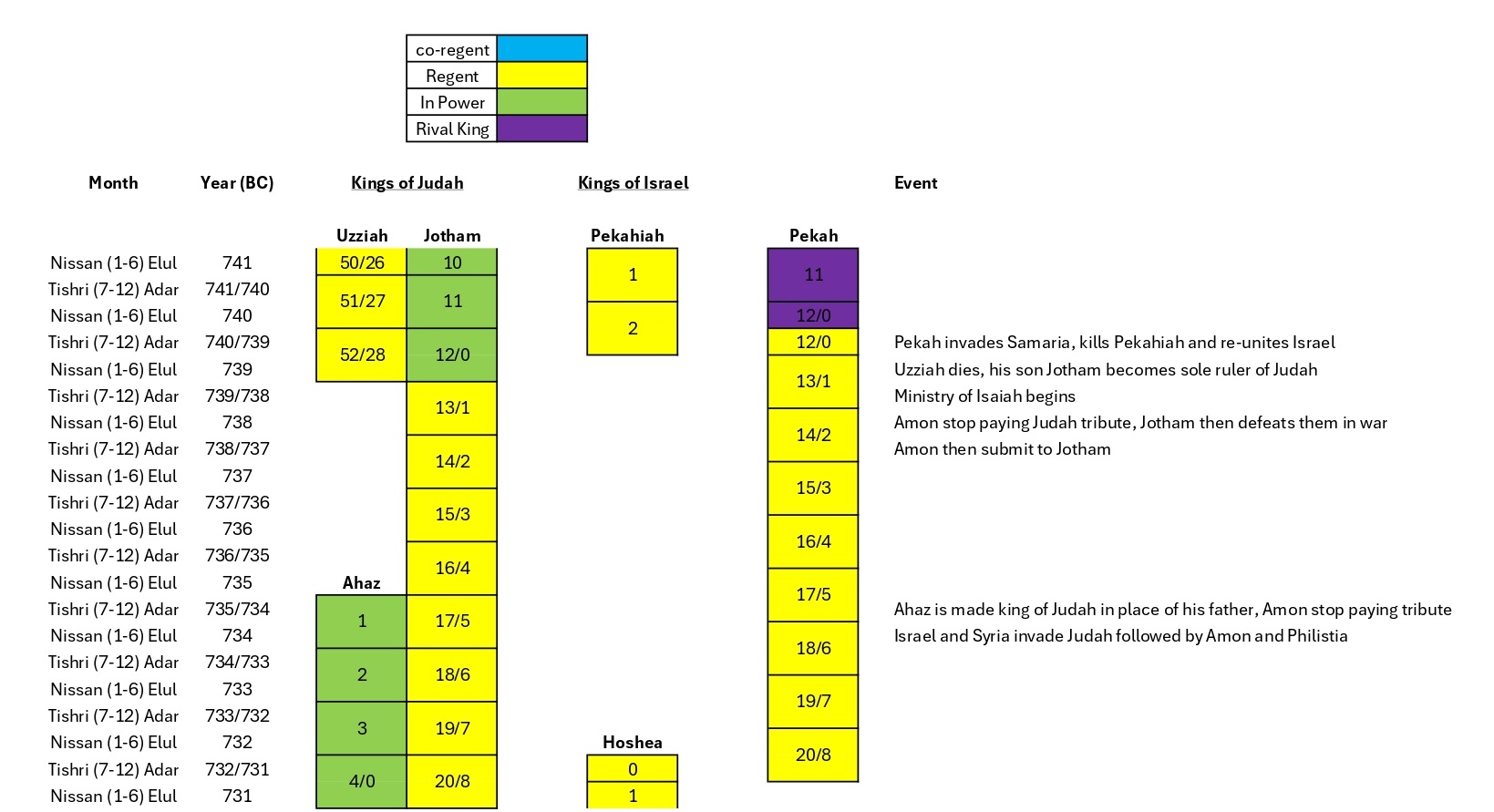
In 739BC Uzziah king of Judah finally dies at the age of 68 after a reign spanning 52 years. He had been living in seclusion since becoming leprous 12 years prior. His son Jotham who had been reigning in his stead now becomes the king in his own right. It is at this time that Isaiah received his calling as a prophet. Isaiah states that he prophesied during the reign of Uzziah and that he was called in the year that the king died (Isaiah 1:1, 6:1). To reconcile these two facts, it must have been whilst Uzziah was on his death bed that Isaiah received his vision. Uzziah and Jotham were both good kings who did what was right in the eyes of the LORD. Jotham is also credited with building the upper gate of the house of the LORD and building extensively upon the wall of the Ophel. However during their reigns, the people became increasingly corrupt. Uzziah’s long reign had brought about great prosperity but with this the people became complacent.
Following the death of Uzziah Ammon stopped paying tribute which led to Jotham making war against them likely in 738BC. Jotham was successful defeating the king of Ammon and forcing the people to submit to him and pay tribute that year and in the following 2 years (738-736BC). The implication is that in 735BC (Jotham’s final year) Ammon likely again rebelled against Judah.
Jotham replaced for Ahaz
In Tishri 735BC Ahaz who was 20 years old is made co-regent with Jotham. At this point Jotham has been reigning 16 years since his father became a leper, and though still alive, he hands over the running of the Kingdom of Judah to his son Ahaz. Whereas Jotham trusted the LORD his son Ahaz was wicked. Ahaz would not only lead Judah into gross idolatry, he even offered his son as a child sacrifice. These were the very the practises of the Canaanites which the LORD had driven out from the land. It is speculated that Ahaz was put on the throne by the people who wanted a pro Assyrian figure. If this is the case, the final year of Jotham must have been troublesome with increased tensions at home and Ammon again rebelling after 3 years. Jotham was a good king who sought to depend on YaHVeH to defend Judah, however Ahaz looked at what he saw was the geo-political realities. In light of the increasing power of Assyria, he represented a belief that if they did not seek an alliance with them, then Judah would be conquered by Assyria in the near future.
A Desperate Alliance
Around this time an alliance had been made between Pekah King of Israel and Rezin King of Syria. Though Israel had often been at war with Syria, the mutual threat of Assyria, and their incursions into the Levant, had led them to unite (especially following the fall of the Kingdom of Arpad in 740BC). Rezin was building a coalition against Assyria which also included Hiram II King of Tyre. It is likely that Pekah and Rezin wanted Judah to join this coalition with Jotham’s unwillingness leading to both Syria and Israel beginning to invade. With the installation of Ahaz on the throne, both Rezin and Pekah made plans to capture Jerusalem.
Israel and Syria invade Judah
In Isaiah 7 we see that Rezin and Pekah were camped in Ephraim ready to march on Jerusalem. Their intention was to capture the city and install their own king in Jerusalem. Isaiah refers to the Son of Tabel who is possibly an anti Assyrian figure who Rezin and Pekah wanted to install in the place of the pro Assyrian Ahaz. (Tabel may refer to the Tobiads, a prominent family who had possessions east of the Jordan.) The idea was to install a king under which Judah would join Rezin’s coalition. In light of the coming invasion, Ahaz went to the aqueduct from the upper pool, to inspect the water situation, and to make the appropriate preparations for a siege. The LORD tells Isaiah to confront Ahaz and give him the word of the LORD. Ahaz is told that Rezin and Pekah will not be successful in conquering Jerusalem however if Ahaz doesn’t trust in the LORD he will not be established.
Rezin and Pekah went on to besiege Jerusalem but were unsuccessful, however they both managed significant victories over Judah. Rezin defeated Judah in battle and took a multitude of captives back to Damascus. He went on to capture Elath, having marched all the way to the southernmost border of Judah, which is at the tip of the Red Sea. Israel likewise struck a major victory against Judah killing a great number of its soldiers including Maaseiah a prince of the royal house. Israel also took a great number of captives and spoil to bring back to Samaria. However Oded the prophet confronted the Israelites about taking their brethren of Judah captive as slaves. In doing so they were bringing on them the wrath of the LORD. The heads of Israel confronted the army and the captives were then brought to Jericho and set free.
Further Decline under Ahaz
Weakened by Israel and Syria the Edomites and Philistines took advantage of the situation. From the south east Edom attacked Judah taking away captives. Furthermore following the retreat of Rezin from Elath Edom then settled there annexing the territory. In the south west the Philistines also invaded the cities of the lowlands and the south of Judah. Following these defeats Ahaz became increasingly unfaithful to YaHVeH. He began to sacrifice to the gods of Syria who had defeated him believing them to be stronger and hoping they would help him.
The reign of Ahaz has barely begun but already he has undone all the good work of his father Jotham and grandfather Uzziah. Ahaz had supplanted his father in taking the throne and sought to take Judah his own way. He rejected the word of the LORD and put his faith in Assyria. The result was that his country was diminished and greatly weakened. Much worse he led Judah into the worst expressions of idolatry, even doing such despicable practices such as child sacrifice. Ahaz inherited a strong kingdom and made it weak; he presided over a holy nation and turned it to a corrupt one.