Domitian Persecution
In our previous article we looked at how John the Apostle had moved to Ephesus which was where he composed his gospel and three letters. In that article the one writing we didn’t mention was the book of Revelation. The book of Revelation was written around 96AD in a time known as the Domitian Persecution. This article will unpack the events leading up to and including the Domitian Persecution.
Domitian restores Emperor Worship
Domitian was the son of the victorious general Vespasian, who had established himself as Emperor following the events of Nero’s death and the crisis of 68AD. Vespasian ruled from 69-79AD and was succeeded by his son Titus (the same person who destroyed Jerusalem and the Temple). After a 2 year reign Titus died in 81AD. Several sources either suggest or implicate that Domitian had a hand in his brother’s death. Either way Domitian succeeded his brother and would reign for 15 years (81-96AD).
There had been an old practise of Emperor Worship which had begun under the first Emperor Augustus. The Emperor was considered a living God and the embodiment of the Roman state. Thus the Emperor Cult revolved around worshipping the might of Rome as represented in the living Emperor. Under previous Emperors certain cities were awarded the title of Neokoros. This was considered a great privilege with the city authorised to build a temple dedicated to the Emperor cult. The cult celebrated the glory and power of Rome and this owed much to its prowess in War. A simple understanding was that if one nation beat another in war, then it’s gods were stronger than theirs. Considering Rome had conquered the entire Mediterranean world, the Romans believed that this had been mandated by the gods and their success evidence of their piety.
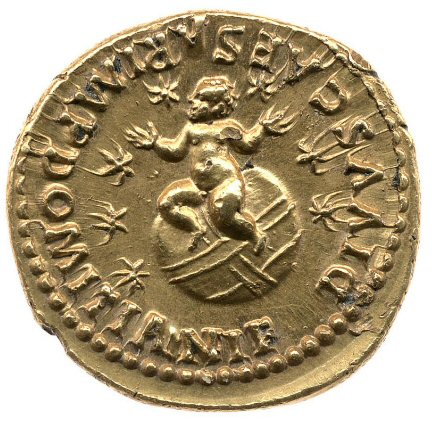
Now Domitian sought to re-instate Emperor worship and to place himself front and centre. Firstly when he became emperor he had the senate declare both his Father Vespasian and brother Titus as gods. Later after his son died he deified him and issued coins to that effect. The coins depicting his son which had the inscription the Divine Caesar son of Emperor Domitian. By calling his dead son a god he was also affirming himself as a living god.
Not only did Domitian style himself as divine he also received the titles of Lord and God. According to Suetonius on one occasion he publicly read out a circular letter in the name of his procurators which referred to Domitian as ‘Our Lord and God’. This became a custom of the way he expected to be addressed. Such was his pride we’re told he even renamed the months of September and October after himself, using his titles Germanicus and Domitianus respectively.
How the emperor cult worked was that a worshipper would offer a libation or a pinch of incense before a statue of the Emperor. They would also declare that Caesar is Lord. The cities that were particularly associated with the cult took great pride in it. Sacrificing was considered a badge of honour and a way of affirming loyalty to the emperor. If there were any question marks over you, one would simply offer a sacrifice and declare Caesar is Lord. This would become an issue for Christians. For Christians there was only One God and One Lord Jesus Christ. Christians would not commit idolatry and worship the Romans Gods and they would declare Jesus is Lord not Caesar.
Division between Jews and Christians
In the early days of the Church Christianity had been seen as a sect of Judaism. Now the Romans considered the Jews backwards due to their strange laws and practice of only worshiping One God. At the same time they recognised that they were an ancient people with an ancient religious practise. As a result the Jews alone were exempted from pagan worship and this included the Emperor Cult. In exchange for this exemption all the Jews would have to do is offer prayers on behalf of the emperor. Therefore as long as Christians were associated with Judaism they enjoyed a level of protection. However as Christianity grew increasing numbers of Gentiles came into the Church. Over time there were increasing divisions between Jews and Christians and even hostility. It was at the end of the first century that the Jews themselves began to disassociate themselves from Christians and even bar them from the synagogue.
With the separation occurring between the synagogue and church, Christians were now being viewed as something distinct. This meant Christians no longer enjoyed the protection they once had. Whereas the Romans considered Judaism an ancient religio (religion), they considered Christianity a new superstitio (superstition). The Romans had no respect for anything new and thought Christianity was mad. This was made worse by misunderstandings of love feasts, the body and blood of Christ and calling one another brother and sister which was interpreted as incest, human sacrifice and cannibalism. Nevertheless the Christians were now vulnerable if they came to the attention of the Romans for not offering to the emperor and the gods. What made this worse was in certain communities there was open hostility between Jews and Christians. This was particularly bad if the city was an neokoros. The Jewish community would make it plain that the Christians were not a part of them. Thus if a Christian gets exposed and they refuse to offer worship to the emperor this will lead to punishment and even execution.
Domitian Persecution
With the revival of the Emperor Cult and the division between Synagogue and Church this set the scene for the events that would follow. Near the end of Domitian’s reign many Christians in Asia Minor suffered for their faith and experienced persecution (c.95-96AD). This was mostly localised and was either carried out by local communities or at the hands of the state. At this point Christianity was despised by Roman society and local rulers were navigating how to deal with the Christian problem as it emerged. It should be noted that the Domitian Persecution refers to the persecution that happened whilst he was emperor. Though Domitian is involved in certain instances it was not an Empire wide event that effected all Christians.
Though there are other sources for the Domitian Persecution, the chief one is the book of Revelation, which is written by John the Apostle around 96AD. John identifies himself as a brother and companion in tribulation which indicates a time of persecution (Revelation 1:9, 2:9-10, 2:13, 6:9). John himself has been exiled to the island of Patmos for preaching the gospel. It was on Patmos that he had a vision of the risen lord Jesus and was commanded to write it down and send it to the seven churches of Asia Minor. This became the book of Revelation with the seven named churches being representative of the whole church.
Persecution forms the background of the message of Revelation, however within the book we have contemporary references to what was going on. In Chapters 2-3 John writes his letters to the 7 Churches of Asia Minor. It is through these that we can get a glimpse of the situation on the ground. Now Smyrna had the honour of being a centre for emperor worship, with a temple (neokoros) dedicated to the cult. Smyrna had a large Jewish community which had come into conflict with the local church. Not only were the Jews in Smyrna opposing the church, but they were drawing attention to the Romans that Christians were not Jews. This meant that they may be obligated to perform Emperor worship. Failure to do so might result in punishment and even death. As we learn from the letter to Smyrna some Christians would be thrown into prison and be afflicted with their faith being tested. Jesus counsels them to be faithful unto death and they will receive the crown of life. What this means is that some may lose their life for their faith. However with this is the promise that if they remain faithful they will receive the reward of eternal life (Revelation 2:9-10). Another city Pergamos also boasted of being a neokoros. A Christian by the name of Antipas had publicly borne witness to Christ and was martyred (Revelation 2:13). This was possibly the result of refusing to worship the emperor. The whole book of Revelation is given in light of persecution but the Domitian persecution is not limited to the New Testament.
Extra Biblical References
Written about the same time as the book of Revelation is the letter of Clement (96AD). In this letter we also have an allusion to the Domitian Persecution. It appears that under Domitian the Church of Rome too encountered persecution and hardships. Clement describes sudden serious and calamitous events that befell the church (Clement 1:1). He also records how certain women among them were persecuted and after suffering horrific tortures finished their courses (Clement 6:2). It is because of the recent events that the Church in Rome was late in responding to an issue that had arisen in Corinth.
The persecution however was not limited to Christian writers. The Roman historian Cassius Dio refers to how Domitian had the consul Flavius Clemens executed on charges of atheism. He goes on to say that many who were of the Jewish opinion were also executed. This charge of atheism was something that was frequently levied against Christians. Though there is some debate, it is likely the executions were not in fact of Jews but of Christians. At this point Romans did not necessarily distinguish between Jewish and Christian belief. Furthermore Flavia Domitilla who was the wife of Flavius Clemens’ (and niece of Domitian) was exiled under Domitian to the island of Pandateria. Early Christian sources record that Flavia was exiled in 95AD and later martyred in 96AD. Moreover Eusebius records that a certain Brutius had written that there were many martyrs under Domitian including Flavia Domitilla.
Conclusion
The persecution of Christians came to an end with the death of Domitian. Domitian was assassinated in September 96AD. Following the end of the Flavian dynasty those who were in exile were allowed to return. John departed from Patmos and returned to the city of Ephesus. He would reside there a few years before dying sometime in his nineties. Though we don’t know the fates of most of the original 12 apostles, tradition holds that John was the only one to die of old age. Irenaeus records that John died in Ephesus during the reign of Trajan (98-117AD). The Domitian Persecution did not endure however the issue of sacrificing to the Emperors would reoccur for Christians who would increasingly find themselves at odds with Rome.