Israel Divided and Uzziah the Leper King (753-740BC)
Ref: 2 Kings 15, 2 Chronicles 26
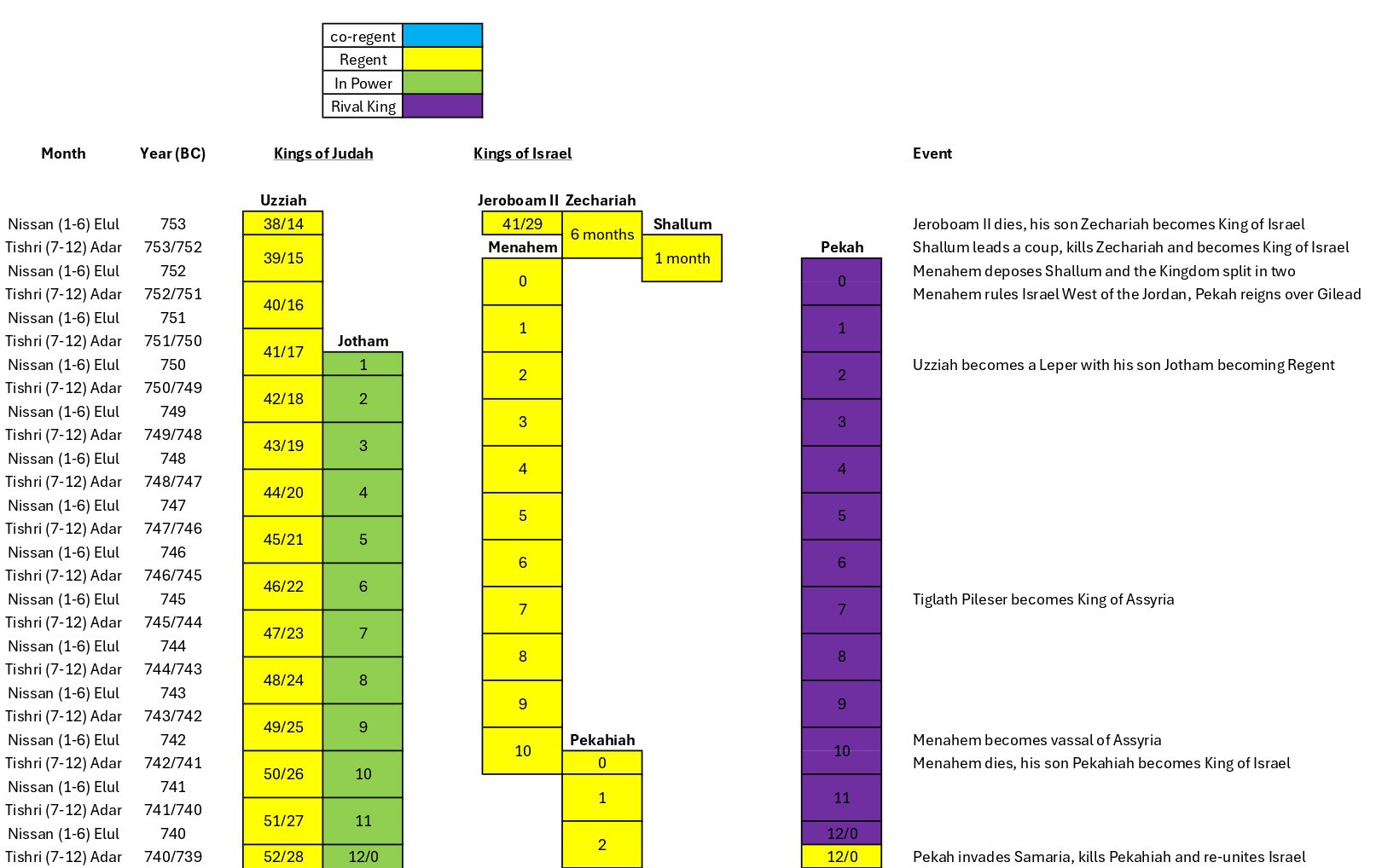
In 753BC both the kingdoms of Israel and Judah were prospering. Jeroboam II had been on the throne nearly 30 years and Uzziah nearly 40 years. However the dynasty of Jeroboam (House of Jehu) would not last and the pride of Uzziah would cost him his rule.
The Fall of the House of Jehu
In 753BC around the month of Elul Jeroboam II died and was succeeded by his son Zechariah. Zechariah continued as his fathers had done but his reign was brief lasting only 6 months. In 752BC, in the month of Adar, Shallum son of Jabesh conspired against Zechariah, and when the time came, he struck and killed the king in front of the people. This brought an end to Jehu’s dynasty which had lasted for four generations (89 years). In fulfilment of the prophecies of Amos and Hosea the dynasty of Jehu which began in violence had ended with violence (Hosea 1:4-5). With the death of Zechariah, the house of Jeroboam II had fallen by the sword (Amos 7:9). Shallum then became King of Israel but only reigned a full month in Samaria.
Israel divided in Two
In the month of Nissan 752BC Menahem son of Gadi led a coup against Shallum. Going up from Tirzah he came to Samaria where he killed Shallum and took the throne. Menahem’s rise to power was hostile and not universally embraced. The people of Tiphsah (Khirbet Tafsah) did not recognise him as king so Menahem attacked the territory as they would not surrender to him. When he captured the town, he was brutal ripping open all the women there who were with child. Whereas Menahem established control over most of the Israel the kingdom was divided into two. Pekah son of Ramaliah, who was an officer in the military, established a breakaway kingdom of Gilead. Whilst Menahem controlled everything west of the Jordan, Pekah had control over the Transjordan area.
Uzziah becomes a Leper
In 750BC Uzziah King of Judah entered the temple seeking to burn incense on the Altar of Incense. This however was located in the Holy Place where only priests were allowed to go. Azariah the High Priest went in after Uzziah, and along with 80 of the priests prevented him from burning incense urging him to get out. Whilst the king was in a rage at the Priests, leprosy broke out upon his forehead. The king hurried out but the leprosy remained. Because of his condition, Uzziah had to dwell in an isolated house, and he was no longer able to carry out the affairs of state. Uzziah’s son Jotham, who was 25 years old, became Co-Regent and ruled in his father’s place.
The Second Rise of Assyria
In 745BC Tiglath Pileser III became King of Assyria. He was a strong ruler and began reversing the decline of Assyria and increasing its power. About 742BC he marched into the Levant and received tribute from Menahem King of Israel and Rezin King of Syria. Menahem exacted 50 shekels of silver from the wealthy men of Israel. This was likely a tax exacted from property owners. He then paid 1,000 talents of silver to Tiglath Pileser. Menahem’s gift was twofold, firstly it was to avoid invasion, but secondly it was to promote friendship with Assyria. Menahem was a tyrant, and he sought to strengthen his political position by allying himself with Assyria. He had opponents like Pekah who might also seek favour from Assyria in an attempt to undermine his rule.
Israel Re-United
Sometime after Tishri 742BC Menahem died and was succeeded by his son Pekahiah as King ruling over Samaria. Pekahiah reigned for two years in Samaria. Pekah seems to have temporarily acknowledged the overlordship of Pekahiah even being counted as an officer in his military. However sometime after Tishri 740BC Pekah, along with Argob, Arieh and 50 men of Gilead, infiltrated Samaria and killed Pekahiah. In doing this Pekah became sole ruler over Israel. Thus Pekah managed to re-unite the whole of Israel for the first time since Zechariah’s overthrow 12 years previous.
Meanwhile in Judah, Hezekiah son of Ahaz, grandson of Jotham the regent, and great grandson of Uzziah King of Judah, was born in 741BC. With 4 living generations of males, the line of David would be firmly established for the years to come.