The Demise of Two Dynasties Part 1 (853-841BC)
Ref: 1 Kings 22:51-53, 2 Kings 1-9, 2 Chronicles 19-20
Under Ahab and Jehoshaphat Israel and Judah had been strong with each king ruling effectively over his territory and exercising control over his neighbours. However with their deaths both kingdoms would face decline under the rule of their immediate descendants.
The Aftermath of Ramoth Gilead
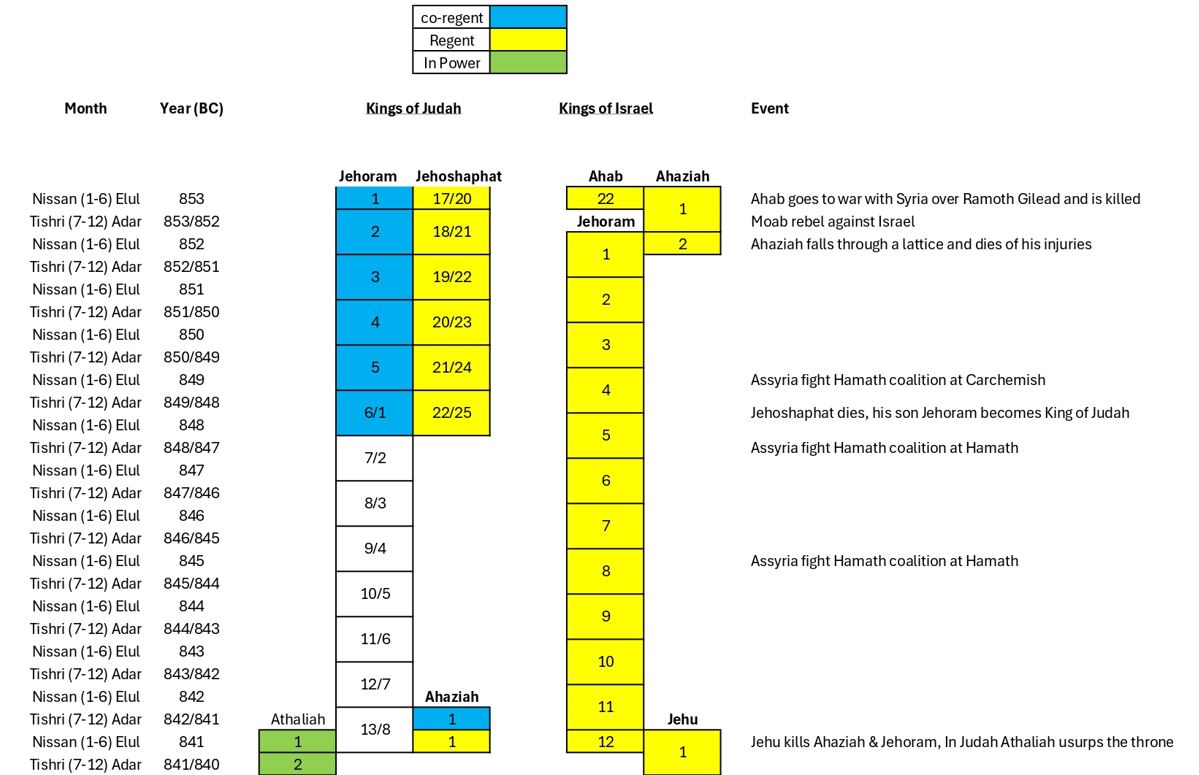
Following the defeat at Ramoth Gilead Jehoshaphat returned to Jerusalem and Ahab’s body was brought back to Samaria to be buried. Ahaziah son of Ahab then became king over Israel. In Judah Jehoshaphat was rebuked by Hanani the prophet for partnering with Ahab, however this didn’t stop him allying himself with Ahab’s children. Jehoshaphat allied himself with Ahaziah on a joint ship building venture with the intention of sailing to Ophir for gold. However the ships were wrecked and never sailed. Jehoshaphat was confronted this time by Eliezer the prophet who declared that this was the LORD’s doing for allying himself with Ahaziah. Meanwhile Ahaziah’s reign was marked by a rebellion with Mesha king of Moab throwing off Israelite authority and ceasing to bring tribute. In 852BC Ahaziah fell through the lattice of his upper room in Samaria and was seriously injured. According to the word of the LORD through Elijah he would not recover and he shortly died of his injury. Jehoram the brother of Ahaziah and son of Ahab then became king over Israel.
Mesha’s Moabite Rebellion
One of Jehoram’s first acts as king was to address the Moabite problem. Following the death of Ahab Mesha King of Moab stopped paying tribute of livestock which Moab supplied Israel. So Jehoram decided to invade Moab and called upon Jehoshaphat to go with him. Jehoshaphat agreed and himself called upon the king of Edom who was his vassal. The three kings marched their armies by way of the wilderness of Edom. Their route was roundabout and after 7 days they had no water for their armies or animals. Following an intervention from Elisha the prophet the LORD provided water for the armies. With the sun reflecting upon the water and in light of the surroundings the Moabites mistook this for blood and thought their enemies had turned on each other. When the Moabites approached the camp the men of Israel attacked sending the Moabites fleeing. The three armies attacked the Moabite towns and fortified cities and spoilt the land as they went. The Moabite army retreated behind the walls of Kir-Hareseth the capital. In a last ditch attempt Mesha with 700 soldiers sought to break through to the King of Edom but was unable. He then took his eldest son and sacrificed him as a burnt offering on the wall. It is unclear whether it was the king of Edom’s son or Mesha’s son. If the king of Edom this would go along way to breaking the alliance. Either way this brought great anger against Israel. The three armies disbanded and departed from the land of Moab.
The Israelite led armies were ultimately unsuccessful in their quest to conquer and subdue Moab. Mesha managed to retain his independence and Israel from this point had lost control over Moab. Mesha would go on to re-take former Moabite cities and capture Israelite cities in the Transjordan.
Likely the following year Moab made an alliance with Ammon and the inhabitants of Mount Seir and proceeded to invade Judah. Thet marched on Judah coming to the place of En Gedi. Jehoshaphat was greatly afraid and sought the LORD. He proclaimed a fast and gathered an assembly. Jahaziel a Levite then proclaimed the word of the LORD. He announced that the battle belonged to the LORD and instructed Judah to go down to the invading army and take position. They would not need to fight for the LORD would be with them. The following day Jehoshaphat led his army with the priests and Levites leading the congregation in worship. They went out into the wilderness of Tekoa to the brook before the wilderness of Jeruel for the enemy was coming up by the ascent of Ziz. Now the LORD set up ambushes against the enemy. The coalition of these three people fell apart. The Ammonites and Moabites turned on those from Mount Seir and slaughtered them. They then turned upon each other. By the time Jehoshaphat and his people reached the place all they found were dead bodies. Over the next three days they plundered all the spoils and on the fourth day they assembled and blessed the LORD in the Valley of Berachah. Jehoshaphat and his people then returned to Jerusalem with the nations left fearful of Judah after what the LORD had done. For the final couple of years of Jehoshaphat’s reign he enjoyed peace from all sides.
Assyrian Incursions into the Levant
In 849BC Shalmaneser III king of Assyria again marched across the Euphrates and according to Assyrian records faced the same coalition as he did previously in 853BC. This time he faced them not at Qarqar but further north at Carchemish. In 848BC he faced them again in Hamath and then again in Hamath in 845BC. However it seems unlikely that Israel would have been a part of these due to them being at war with Syria. The coalition led by Hamath and Syria would have continued but it is only for the battle of Qarqar that the other nations are identified in Assyrian sources.
The Demise of Judah under Jehoram
In 848BC Jehoshaphat died and Jehoram his son became sole ruler of Judah. Jehoshaphat handed over a strong kingdom to Jehoram. The Edomites were a vassal with the Philistines and Arabians paying tribute. Moreover there was peace with Israel and Moab and Ammon feared Judah after their failed campaign. This however all fell apart during the reign of Jehoram.
Jehoram didn’t follow in the footsteps of his father but instead walked in the ways of his father in law Ahab. Jehoram had married Athaliah who was the daughter of Ahab and Jezebel. Instead of following the accession year system of Judah Jehoram synchronised with Israel’s non-accession year system with the 25th year of his father Jehoshaphat counted as the first year of his reign. Jehoram adopted the worship of Baal following the lead of Israel. Now when Baasha and Omri came to the throne they proceeded to strengthen their positions by killing all the surviving members of the previous dynasty. Jehoram did in like manner but in far worse fashion. Jehoshaphat had 7 sons but whereas he gave the kingdom to his firstborn Jehoram, he gave his other sons gold and silver and placed them in charge of fortified cities. Upon becoming King of Judah Jehoram proceeded to kill all his brothers along with any other members of royal house to eliminate any rivals to the throne. This however would serve to weaken and destabilise his own kingdom and authority.
Now Edom were already discontented following the failed Moabite invasion. Moreover they had lost territory to Mesha King of Moab in the proceeding years. Under Jehoshaphat they had remained loyal although near the end of his reign had not aided him when Judah was invaded by Moab, Ammon and more significantly those of Mount Seir which was in the region of Edom possibly those from within their own kingdom. Under Jehoram Edom revolted and took their opportunity to gain their independence. Jehoram marched into Edom with his officers and chariots and came to the place of Zair. Here his army was surrounded by the Edomites. During the night Jehoram seized his opportunity to escape. He rose up and attacked the Edomites breaking through their lines. The King of Judah with all his troops then fled from the Edomites. From this point Edom was no longer under the control of Judah. Moreover at the same time in the west the city of Libnah also revolted against Judah and was lost.
Following this the Philistines and Arabians who had paid tribute to Jehoshaphat also rebelled. They not only withheld tribute but joined forces to invade a weakened Judah. The joint forces managed to invade Jerusalem itself. They carried off all the possessions they found in the kings house and also took captive his wives and all his sons except his youngest Ahaziah. In less than ten years Judah had gone from a regional power to Jerusalem being invaded and the king's household taken captive. From the strong rule of Jehoshaphat and Ahab Judah and Israel had been brought low and worse was still to come in Part 2.